Age-Friendly Cities: What Makes a Community Great for Seniors
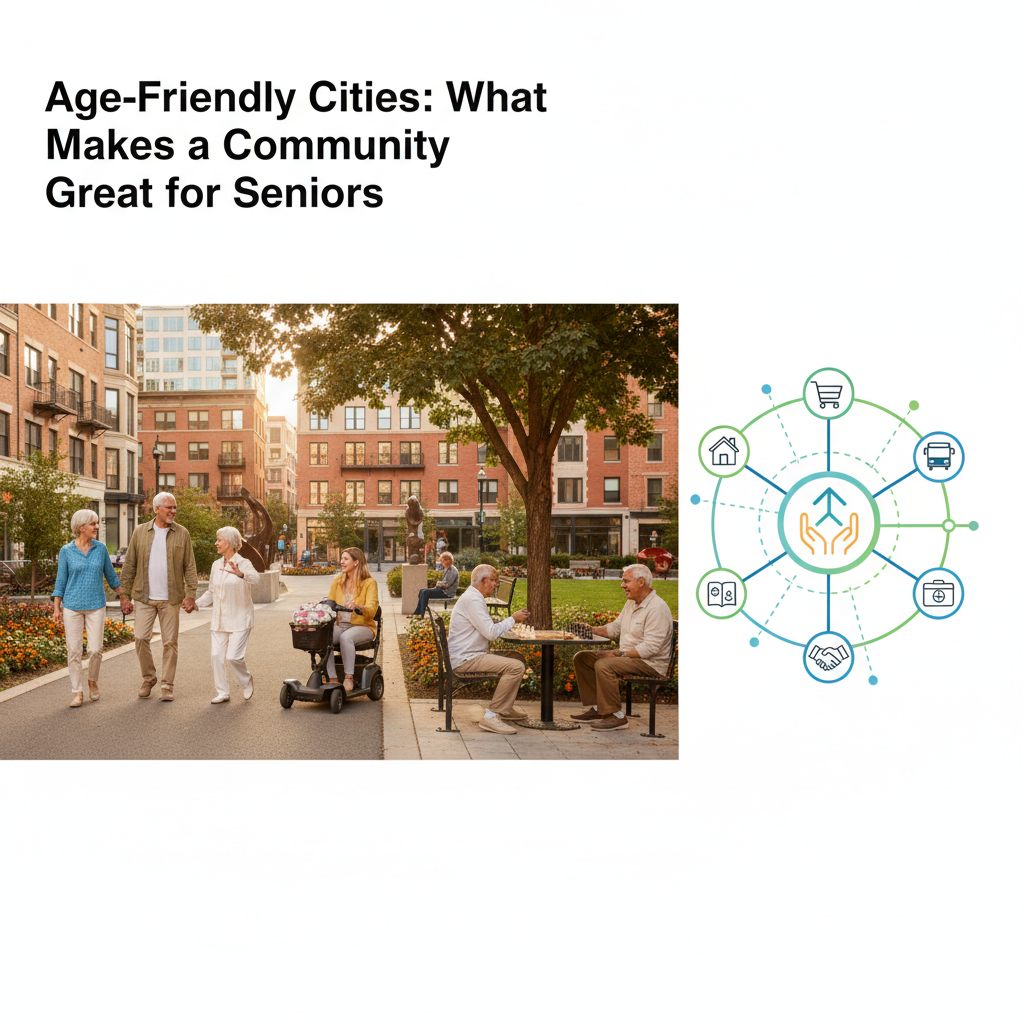
Age-friendly cities are communities designed so that people of all ages, including seniors, can live active, healthy, and socially connected lives. With more than 90 percent of adults over 65 expressing a desire to age in place, according to AARP, what makes a community great for seniors has become a critical question for urban planners, policymakers, and families evaluating where to live in later life.
The WHO Framework
The World Health Organization launched the Global Network of Age-Friendly Cities and Communities in 2010, establishing a framework that has been adopted by more than 1,400 communities across 51 countries. The framework identifies eight domains that determine how age-friendly a community is: outdoor spaces and buildings, transportation, housing, social participation, respect and social inclusion, civic participation and employment, communication and information, and community support and health services.
In the United States, AARP's Network of Age-Friendly States and Communities has enrolled more than 740 communities, representing every state and territory. Participation requires a formal commitment by local government to assess seniors' needs, develop an action plan, and implement improvements across the WHO domains.
Transportation: The Make-or-Break Factor
Transportation access is consistently identified as the single most important factor in senior quality of life, according to research from the National Aging and Disability Transportation Center. When seniors can no longer drive — a transition that affects most people at some point — access to healthcare, social activities, groceries, and community life depends entirely on the availability of alternative transportation.
Age-friendly communities invest in accessible public transit with features like low-floor buses, clear signage, covered waiting areas with seating, and routes that connect to medical facilities, senior centers, and shopping areas. Beyond traditional transit, many communities have developed specialized programs such as volunteer driver networks, subsidized ride-sharing partnerships, and demand-responsive micro-transit services that pick up seniors at their doors.
Portland, Oregon, is frequently cited as a leader in senior-friendly transportation. The city's TriMet system offers reduced fares for seniors, accessible vehicles on all routes, and a complementary paratransit service for those who cannot use fixed-route transit. The result is measurably higher mobility and social engagement among the city's older residents compared to national averages.
Housing: Beyond the Nursing Home
Age-friendly housing goes beyond nursing homes and assisted living facilities. It encompasses universal design principles that make standard homes accessible throughout the lifespan — features like zero-step entries, wider doorways, lever-style door handles, walk-in showers, and main-floor bedrooms.
The affordability dimension is equally critical. The Joint Center for Housing Studies at Harvard University reports that more than 10 million seniors spend over 30 percent of their income on housing, with 5 million spending more than 50 percent. For these seniors, housing costs crowd out spending on food, medications, and healthcare.
Innovative models are emerging to address these challenges. Village-to-Village networks help seniors organize neighborhood-level support systems, sharing services like home repair, transportation, and social programming. Accessory dwelling units (ADUs), sometimes called granny flats, allow families to create affordable housing for aging parents on their existing property. Co-housing communities designed specifically for seniors offer shared spaces and mutual support while maintaining individual privacy.
Walkability and Public Spaces
Walkable neighborhoods with well-maintained sidewalks, frequent benches, adequate lighting, and accessible crosswalks enable seniors to maintain physical activity and social connection. The National Institute on Aging has documented that seniors living in walkable neighborhoods are 30 percent more likely to meet physical activity guidelines and report significantly higher levels of life satisfaction.
Public spaces — parks, libraries, community centers, and gathering places — serve as the social infrastructure of age-friendly communities. When these spaces are designed with senior needs in mind, including accessible restrooms, shaded seating, smooth pathways, and proximity to transit, they become vital hubs for combating social isolation.
Healthcare Access
An age-friendly community must provide accessible, comprehensive healthcare services. This includes not only proximity to hospitals and clinics but also availability of geriatric specialists, home health services, mental health support, and preventive care programs.
Communities that participate in the Age-Friendly Health Systems initiative, led by the John A. Hartford Foundation and the Institute for Healthcare Improvement, align their healthcare services around the 4Ms framework: What Matters, Medication, Mentation, and Mobility. This approach ensures that healthcare is oriented around the goals and needs of older adults rather than disease-specific treatment models.
Social Inclusion and Engagement
Loneliness and social isolation affect approximately one-third of adults over 65, according to the National Academies of Sciences. Age-friendly communities actively combat isolation through senior center programming, intergenerational activities, volunteer opportunities, lifelong learning programs, and technology training that helps seniors stay connected digitally.
The concept of "social prescribing" — where healthcare providers refer patients to community activities and social groups rather than (or in addition to) medications — has gained traction in age-friendly communities as a strategy for addressing the health impacts of isolation.
Top Age-Friendly Cities in America
While every community has room for improvement, several U.S. cities consistently rank among the most age-friendly. New York City's Age-Friendly initiative, launched in 2009, was among the first in the nation and has implemented improvements across all eight WHO domains. Pittsburgh has gained recognition for its focus on intergenerational programming and inclusive urban design. Austin, Texas, has been praised for its innovative transportation solutions and vibrant senior programming.
Smaller communities are also making impressive strides. West Des Moines, Iowa, has implemented a comprehensive age-friendly plan that includes housing modifications, community health worker programs, and senior-specific emergency preparedness planning.
Frequently Asked Questions
How can I find out if my community is age-friendly?
Visit AARP's Network of Age-Friendly States and Communities website to check if your community is enrolled. Even if it is not formally participating, you can use the WHO framework to evaluate your community's strengths and weaknesses across the eight domains.
What can individuals do to make their community more age-friendly?
Attend city council meetings and advocate for senior-inclusive policies, join or start a local aging advisory committee, volunteer with organizations serving seniors, and support ballot measures that fund public transportation, affordable housing, and community services.
Are suburbs or cities better for aging?
Both can be age-friendly, but they face different challenges. Cities typically offer better transit and walkability but may have higher costs. Suburbs often provide more affordable housing but can be car-dependent. The key is whether the specific community has invested in infrastructure and services that support aging in place.
Conclusion
Creating age-friendly cities is not just about accommodating seniors — it is about building communities that work better for everyone. The infrastructure that makes a city great for a 75-year-old — smooth sidewalks, accessible transit, welcoming public spaces, affordable housing — also benefits parents with strollers, people with disabilities, and anyone who values a connected, walkable community. As America's population continues to age, the communities that embrace the age-friendly framework will not only serve their senior residents better but will become more livable, equitable, and resilient for all.
Written by
More Posts
We Tried It: Are You Allergic to the Flu Shot? Here's How to Tell
Flu shot allergic reactions affect roughly 1.3 per million doses, yet many seniors skip vaccination out of fear. Here's how to identify a true allergy...
We Tried It: Are You Allergic to the Flu Shot? Here's How to Tell
A true allergic reaction to the flu shot affects fewer than 1.3 per million doses. Learn how to distinguish normal side effects from genuine allergy s...
We Tried It: Are You Allergic to the Flu Shot? Here's How to Tell
A true allergy to the flu shot affects fewer than 1.3 per million doses, yet many older adults skip vaccination out of fear. Here's what the research...
Be the first to comment